
Hidden Stories of the Earth - Çatalhöyük
We’re back with the second post of our blog series “Stories Beneath the Soil.”In this article, we’ll talk about an ancient settlement from our own country. When we think of ancient settlements in Türkiye, one name immediately comes to mind. Yes — today we’ll be talking about that magnificent place: Çatalhöyük.
When we look at Çatalhöyük, it doesn’t just feel like an old settlement — it feels like one big family. Thousands of years ago, people lived side by side here. They cooked at the same hearth, shared their joys and sorrows together.That feeling is so familiar to us even today.Maybe times have changed, but the emotions we live with are still the same. That’s exactly why we wanted to tell you about one of the most important places in our country — Çatalhöyük.
As we journey deep into history, we sometimes come across places that help us understand not only the past, but also the present and the future.Çatalhöyük is one of those places.Located near the district of Çumra in Konya, this ancient settlement was continuously inhabited starting around 7400 BCE. Today we see it as an archaeological site, but back then it was a lively settlement — a world where people lived together, produced, and gave meaning to life.Even in an age before writing was invented, people gathered here and took the first steps toward civilization.
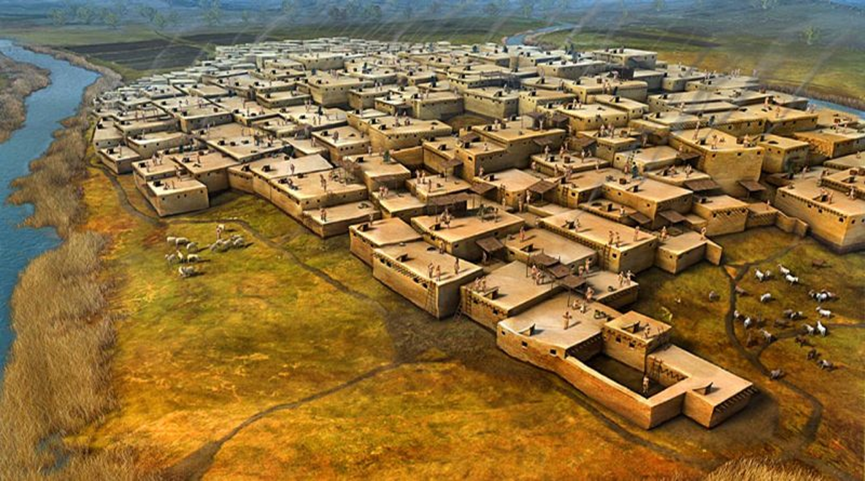
One of the most fascinating things that makes Çatalhöyük so unique is its layout.In modern cities, we have streets, sidewalks, and roads — but back then, none of those existed.Here, the houses were built right next to each other, wall to wall.People entered their homes through the roof and moved from house to house across the rooftops.So basically, instead of streets, they had rooftops!This design wasn’t just creative — it also kept the community safe from outside threats and made living together much easier.Even thousands of years ago, people at Çatalhöyük had already embraced the idea of community living.
But life there wasn’t only about shelter — it was about production too.In the fertile lands of the Konya Plain, people began growing grains like wheat and barley, and domesticating animals such as sheep and goats.They were no longer just hunters and gatherers; they were learning how to produce their own food.And that changed everything.This was one of the biggest turning points in human history — the beginning of agriculture.With farming came permanent settlements and growing communities.Because there was now a surplus of food, people could divide work among themselves.Some farmed, some built houses or tools, while others focused on different tasks.In short, the foundations of modern city life were being built right here, in Çatalhöyük.

The people of Çatalhöyük didn’t just focus on production — they also cared deeply about giving meaning to life.The paintings on their walls, the small sculptures and figurines they made — all of these reflected their beliefs and worldview.The Mother Goddess figures symbolized fertility and abundance, showing how important nature and creation were to them.They even buried their deceased family members inside their homes, a powerful sign of respect for both their loved ones and their ancestors.The hunting scenes and abstract patterns painted on the walls prove that art was already a natural part of life — even thousands of years ago.
Today, Çatalhöyük connects us not only to the past, but also to the present.Since being added to the UNESCO World Heritage List in 2012, it has become a truly special archaeological site where visitors can literally step into history.The area is well-preserved — with walking paths, guide signs, and protective shelters that let people explore safely.Under the protective roof, you can see the foundations of ancient houses, still standing after thousands of years.With guided tours, visitors can imagine what life must have been like back then — the rhythm, the routines, the community.And at the visitor center, models, information panels, and realistic reconstructions open a window into one of the most important chapters of human history.

The area where Çatalhöyük is located is calm and peaceful — a quiet stretch of land that feels almost frozen in time.It’s about a 45-minute drive from Konya city center, and once you arrive, you realize you’re not just visiting an archaeological site.You’re stepping into the heart of Anatolia’s thousands of years of culture and history.As you walk in silence, it’s easy to imagine what life must have been like for the people who lived here so long ago.Around the site, there are also green areas where visitors can relax, have a picnic, or simply enjoy the nature around them.So, Çatalhöyük isn’t just a destination for history lovers — it’s also the perfect spot for anyone who wants to spend a peaceful day surrounded by nature.
In the end, Çatalhöyük isn’t just a remnant of the past — it’s a living memory that reminds us who we are today.We might live in modern cities now, but we’re still the inheritors of the people who once walked across rooftops thousands of years ago.Visiting Çatalhöyük is like taking a journey into your own past.The first steps taken there laid the foundations for the cities we live in today.That’s why Çatalhöyük is not just Turkey’s heritage — it’s a shared legacy for all of us.Protecting it, understanding it, and passing it on to future generations is our responsibility.So, wouldn’t you like to take a trip to Çatalhöyük and walk through history yourself?
Written by: Yeşim Yılmaz


Comments